Martin Zimmermann (ed.)
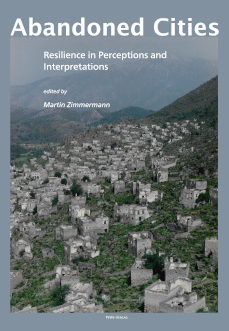
Abandoned Cities. Resilience in Perceptions and Interpretations
Format: 30 x 21 cm — Hardcover
Umfang: 166 Seiten, 36 meist farbige Abbildungen im Text
ISBN: 978-3-935012-76-8
Preis: 48,00 €
© PeWe-Verlag 2026
With contributions by A. Acker, O. Bobou, H. Gasperin, M. Gunko, C.T. Halperin, E. Hartmann, D. Heberle Viegas, B. Hensel, R.N. Klöckl-Zorić, B. Kovács, M. Kühn, E. Lapina-Kratasiuk, J.-B. LeMoine, N. Moragas Segura, A. Pecci, A. Plattner, M. S. Pol, R. Raja, C. Ramos Hernandez, S. Reidl, M. Schramm, I. Shirobokova, J. Silva de Medeiros, M. Torras Freixa, E. Trinkl, P. Vieira, M. E. Voyatzis, D. Weidgenannt, O. Zaporozhets and M. Zimmermann,.
This volume is the second collective publication featuring projects funded by the Gerda Henkel Foundation as part of the ‘Lost Cities: Living with and Perceiving Abandoned Cities in Cultures around the World’ funding program, and serves to presents their initial findings. The phenomenon of lost cities manifests in various forms across regions and time periods. How these ruined cities are perceived, however, changes dynamically over time, as it depends on specific historical and cultural conditions. The research program funded by the Gerda Henkel Foundation is particularly interested in the ruins themselves and how they have been used across different eras and cultures. The diverse cultural and historical perspectives on abandoned sites create a promising area for research. The articles of this book are strong examples of this. Together, they trace a long chronology from the 2nd millennium BC to the present and cover regions from Central America to Europe, Central Asia, and the Middle East. The book takes readers on a journey stretching from Bronze Age Hathor via ancient Arcadia, the Ancient Maya, Teotihuacan in Mexico, Ani in Armenia, the Amazonas cities, to Johanngeorgenstadt in East Germany, and includes articles on general issues relating to the interpretation
of ruins.