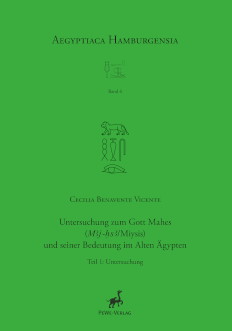
Cecilia Benavente Vicente
Untersuchung zum Gott Mahes (Miysis) und seiner Bedeutung im Alten Ägypten
Aegyptiaca Hamburgensia — Band 6
Format: 29 x 21 cm — Hardcover
Teil1: Untersuchung
Umfang: 180 Seiten
Teil 2: Anhang
Umfang: 244 Seiten mit zahlreichen Abbildungen
ISBN: 978-3-935012-75-1
Preis: 98,00 €
© PeWe-Verlag 2026
Erscheinungstermin: Ende Juni
Der Gott Mahes gehört bislang zu den wenig erforschten löwengestaltigen Gottheiten des altägyptischen Pantheons, obwohl sein Kult vom Mittleren Reich bis in die römische Zeit belegt ist.
Die vorliegende Untersuchung wertet die überlieferten Text- und Bildquellen zum Gott Mahes erstmals systematisch aus. Im Mittelpunkt stehen die Entstehung und Entwicklung des Gottesbildes, seine Beziehungen zu anderen Gottheiten, seine Rolle im Verhältnis zu Königtum und Individuum sowie die Entwicklung und Ausbreitung seines Kultes.
Ein besonderer Schwerpunkt liegt auf dem Hauptkultort Leontopolis (Tell el-Moqdam). Durch die Neubewertung der Quellen gelingt sowohl eine Rekonstruktion der Kultlandschaft von Leontopolis als auch die Bestimmung der Rolle des Mahes innerhalb dieser Kultlandschaft.
Es ergibt sich das Bild einer jugendlichen, solaren Gottheit mit kämpferischem und schützendem Wesen, die eng mit den lokalen Traditionen ihrer Kultorte verbunden war.
Mahes is one of the least-studied leonine deities of the Ancient Egyptian pantheon, although his cult is attested from the Middle Kingdom through the Roman Period.
This study systematically evaluates the extant textual and iconographic sources relating to the god Mahes. It focuses on the origin and development of his divine character, his relationships with other deities, his role in relation to kingship and the individual, as well as the development and spread of his cult.
Particular attention is given to the main cult site of Leontopolis (Tell el-Moqdam). Through a reevaluation of the sources, it becomes possible both to reconstruct the cultic landscape of Leontopolis and to determine the role of Mahes within this landscape.
The result is an image of a youthful solar deity with a martial and protective nature, closely connected to the local traditions of his cult centres.